History

All history is local, in this case the locality is Milwaukee

Riverside Park: a dream, a long decline, and a bright future

Milwaukee's Riverside Park was designed in the 1890s by Frederick Law Olmsted, the pioneering landscape designer who was also responsible for Lake and Washington parks in Milwaukee, Central Park in Manhattan, and much more. Only traces of Olmsted's plan remain.

Milwaukee’s Riverside Park was designed in the 1890s by Frederick Law Olmsted, the pioneering landscape designer who was also responsible for Lake and Washington parks in Milwaukee, Central Park in Manhattan, and much more. Only traces of Olmsted’s plan remain.

Frederick Law Olmsted (the designer of, among other things, Manhattan’s Central Park), also left a lasting mark on Milwaukee. In the 1890s his landscape architectural firm designed three Milwaukee County Parks; Lake Park, River Park (called Riverside after 1900), and West Park (renamed Washington Park).

The plan called for Lake and River parks to be united by an elegant boulevard, today’s East Newberry Boulevard. While Lake Park and Washington Park ultimately came fairly close to Olmsted’s vision, development of River Park was never fully completed, although some key features were built, and can be seen today – if you know where to look.

(more…)

Someone has a case of the Mondays

In 1942, photographer Jack Delano snapped this image of employees of Western Fuel Commpany having lunch in their locker room at the firm's Seventeenth Street Coal Dock office. It's December 1942, and World War II has been going on for a year. Somehow one feels they are waiting for the photographer to leave so they can resume the poker game. Photo courtesy Farm Security Administration - Office of War Information Photograph Collection (Library of Congress), [reproduction number, LC-USW3- 020002-D [P&P] LOT 214]

In December 1942, photographer Jack Delano snapped this image of employees of Milwaukee’s Western Fuel Company having lunch in their locker room at the firm’s Seventeenth Street Coal Dock office. Somehow one feels they are waiting for the photographer to leave so they can resume the poker game. Photo courtesy Farm Security Administration – Office of War Information Photograph Collection (Library of Congress), [reproduction number, LC-USW3- 020002-D [P&P] LOT 214]

Photo Friday: War Memorial, 1957


Eero Saarinen’s Milwaukee Art Museum (originally Milwaukee War Memorial), as it originally appeared in the 1950s. This photograph was taken by Balthazar Korab. Credit: Library of Congress, Prints & Photographs Division, Balthazar Korab Archive at the Library of Congress, [reproduction number, e.g., LC-DIG-krb-00175]

Eero Saarinen’s Milwaukee County War Memorial Center, as it appeared around the time of its dedication in 1957. Saarinen, who also designed the St. Louis Arch, died in 1961 while undergoing surgery. He was 51. This photograph was taken by Balthazar Korab. Credit: Library of Congress, Prints and Photographs Division, Balthazar Korab Archive at the Library of Congress, [reproduction number, e.g., LC-DIG-krb-00175]

Photo Friday: Downtown, 1901

Flashback Friday: Downtown Milwaukee, 1901

In 1901, a photographer from the Detroit Publishing Company captured this view of the Milwaukee River in downtown Milwaukee from Sycamore Street (now West Michigan Avenue). Much has changed in 113 years, but in middle distance you can see what City Hall looks like without its modern crust of semi-permanent scaffolding. Photo courtesy Library of Congress, Prints & Photographs Division, Detroit Publishing Company Collection, [reproduction number, e.g., LC-D4-10865]

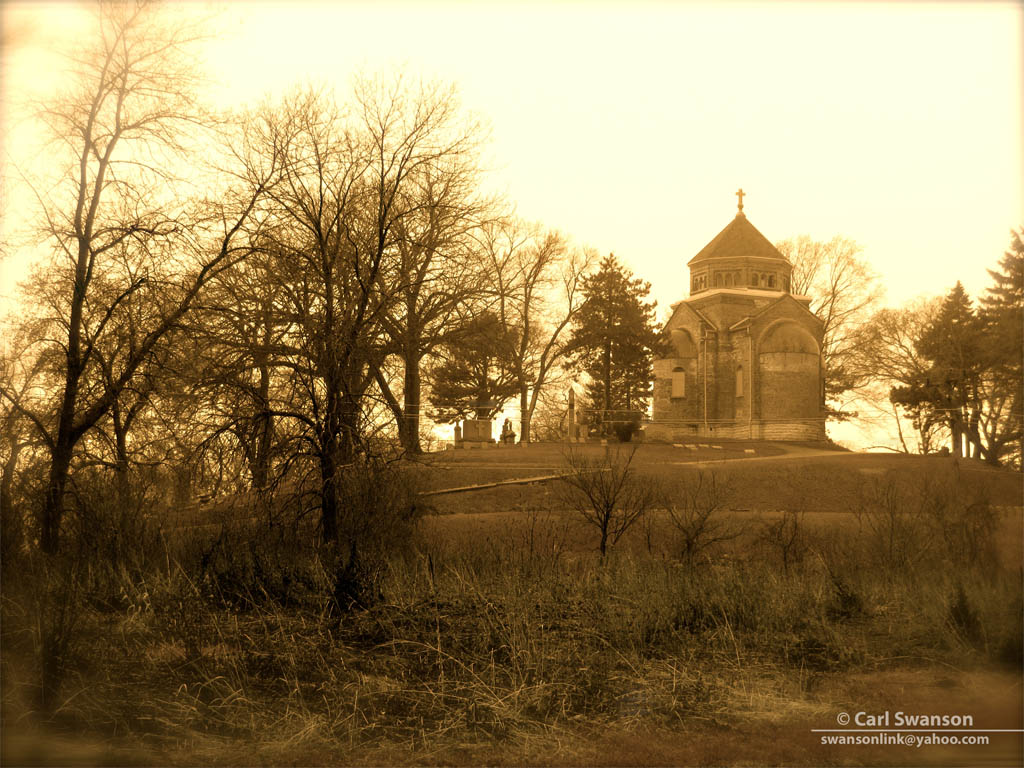
Cemetery chapel harbors a mystery

Milwaukee Calvary Cemetery Chapel exterior view, east side of building

The mausoleum beneath the 1899 Cream City brick chapel in Milwaukee’s Calvary Cemetery seems an ideal last resting place. The elegant little chapel features soaring arches rising to a domed ceiling, a rose window, and a high altar. It was designed by Erhard Brielmaier, the same man responsible for Milwaukee’s Basilica of St. Josaphat.

Its location is significant too. Overlooking today’s Miller Park, the chapel stands at the eastern edge of Calvary Cemetery atop one of the highest elevations in Milwaukee. Called Jesuit Hill, it is largely given over to burial places of clergy and members of Catholic religious orders. It was the location of a large wooden cross until the chapel’s construction.

The cemetery itself contains a great deal of local history. Consecrated in 1857, it is the oldest major Catholic cemetery in the city. The grave of Solomon Juneau, co-founder of Milwaukee, is here, along with brewer Frederick Miller, meatpacker Patrick Cudahy … and architect Erhard Brielmaier.

(more…)

Riverwest: A railroad ran through it

Beer Line Trail, Milwaukee Riverwest neighborhood. Carl Swanson photo

Beer Line Trail, Milwaukee Riverwest neighborhood. Carl Swanson photo

Six decades ago in the Riverwest neighborhood on Milwaukee’s north side, a kindergarten boy stood at the edge of the Fratney Street School playground and watched a steam locomotive struggle past with a seemingly endless train of railroad cars.

(more…)