A Confederate grave in Milwaukee

Milwaukee Calvary Cemetery Civil War grave of Joseph Shefhey.

The peaked headstone of Joseph Sheehy denotes a Confederate Civil War veteran, the only one amid a sea of rounded headstones belonging to Union veterans in Milwaukee’s Calvary Cemetery. Photo by Carl Swanson

Update: In summer, 2016, the Department of Veterans Affairs’ National Cemetery Administration in Washington, D.C. determined the grave marker incorrectly identified the soldier as Confederate. The marker was subsequently reground with a Union-style rounded top. Additionally, it was learned the stone misspells the soldier’s name. This post has been edited to reflect the correct spelling throughout.

A distinctive headstone in Milwaukee’s Calvary Cemetery marks the last resting place of a Confederate Civil War soldier — the only one in row upon row of Union veterans of that conflict. But was Joseph Sheehy mistakenly buried as a rebel?

(more…)

Revisiting Kern Park’s “Lover’s Lane”

This early 1900s postcard shows Milwaukee's "Lover's Lane." Carl Swanson collection

This early 1900s postcard shows Milwaukee’s “Lover’s Lane.” Carl Swanson collection

An antique postcard adds a fresh perspective to a post from last year on the end of Kern Park’s “Lover’s Lane.” Read it here.Carl_sig

O.W. Wight, the most famous Milwaukeean you’ve never heard of

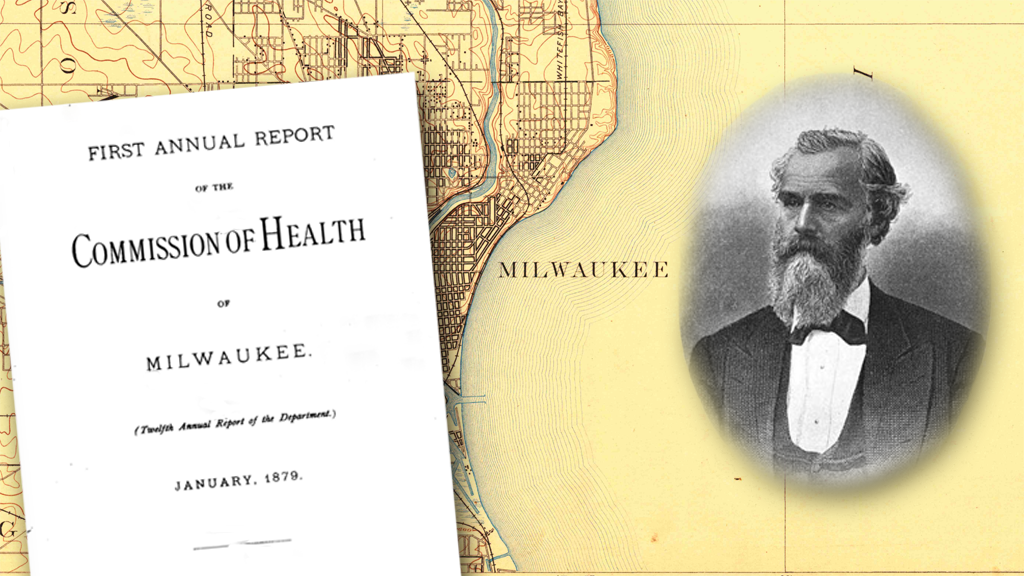
O.W. Wight served as Milwaukee's commissioner of Health in the late 1870s, and was instrumental in sweeping reforms that greatly improved public health and welfare. Illustration by Carl Swanson

O.W. Wight served as Milwaukee’s commissioner of Health in the late 1870s, and was instrumental in sweeping reforms that greatly improved public health and welfare. Illustration by Carl Swanson

My friends at OnMilwaukee.com have very kindy reprinted a blog post on O.W. Wight, the city’s crusading Commissioner of Health in the 1870s. In addition to being a medical doctor, attorney, and world traveler, Wight was a gifted and powerful writer, as you’ll see from the quotes in the article. If you missed this entry the first time around, I hope you’ll head over to OnMilwaukee.com and take a look.

Also, Wight’s efforts to clean up Milwaukee’s ice supply are covered in a separate Milwaukee Notebook article.Carl_sigMKE_share

County debates fate of aging Estabrook Park dam

The Depression-era dam across the Milwaukee River in Estabrook Park. Photo by Carl Swanson

The Depression-era dam across the Milwaukee River in Estabrook Park. Photo by Carl Swanson

The Milwaukee County Executive wants it gone, Milwaukee County Parks wants it gone, but the deteriorating Estabrook Park dam got a vote of confidence this week from the County Board, which voted $1.6 million in repairs. Read about the dam and its roots in a Depression-era make-work program in my latest OnMilwaukee.com article.

Carl_sig

What’s in a number? More than you might think

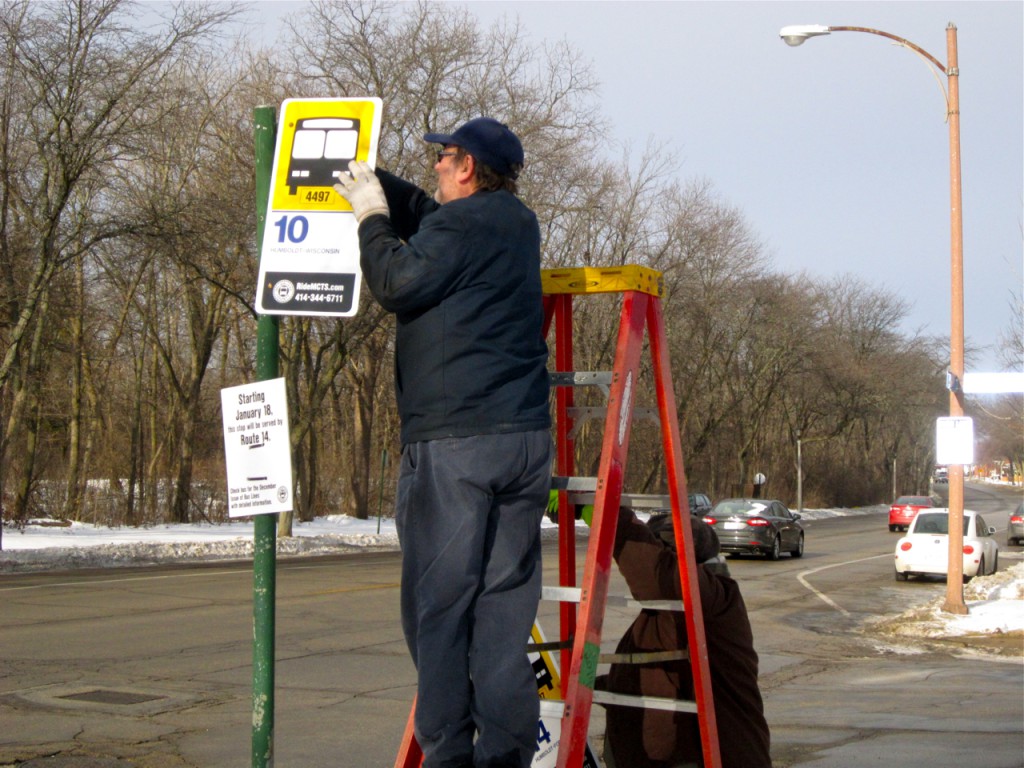
What are these workers doing? Stay tuned for the story later this week! Photo by JohnSwanson

Removing transit history one sign at a time. Photo by John Swanson

The end of Milwaukee County Transit’s Route 10 service closes a century-old chapter in Milwaukee history. Read the full story at OnMilwaukee.com here.Carl_sig

2014 in review

The WordPress.com stats helper monkeys prepared a 2014 annual report for this blog.

Here’s an excerpt:

The concert hall at the Sydney Opera House holds 2,700 people. This blog was viewed about 23,000 times in 2014. If it were a concert at Sydney Opera House, it would take about 9 sold-out performances for that many people to see it. There were 384 pictures uploaded. That’s about a picture per day.

The top three posts were:

Secrets of Shorewood’s Hubbard Park

Amid the ruins of Gordon Park’s riverside bathhouse

In 1901, Riverwest residents battled on the frozen Milwaukee River

Thanks everyone for a great year! The first Milwaukee history post of 2105 arrives later today!Carl_sig

Milwaukee’s Center Street icehouse was a Riverwest landmark

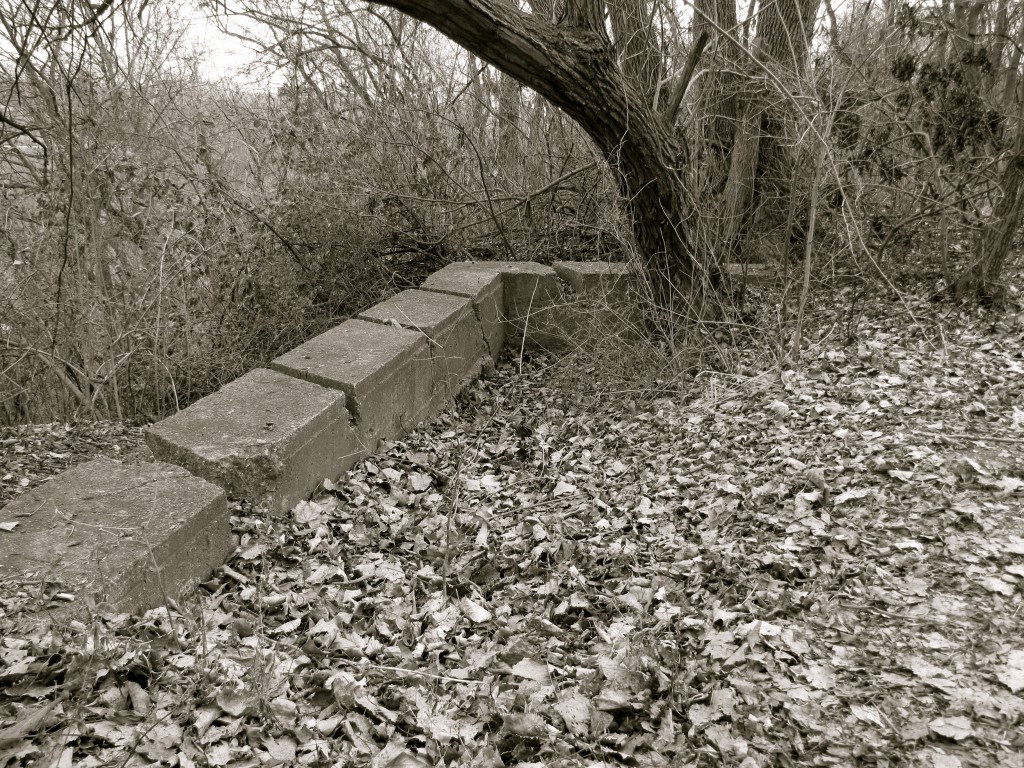
This concrete foundation, atop a river bluff south of Gordon Park, supported Wisconsin Lakes Ice & Cartage Company's Center Street icehouse, which was destroyed in a massive fire 103 years ago. Carl Swanson photo

This concrete foundation, atop a river bluff south of Gordon Park, was part of the Wisconsin Lakes Ice & Cartage Company’s Center Street icehouse, destroyed in a massive fire a century ago. Carl Swanson photo

A concrete foundation in the woods south of Gordon Park in Milwaukee’s Riverwest neighborhood is all that remains of the Wisconsin Lakes Ice & Cartage Co. Center Street icehouse. The 350 x 100-foot icehouse, built in the late 1800s alongside the Chicago, Milwaukee & St. Paul RR’s “Beer Line,” was one of several icehouses on the upper Milwaukee River. The icehouse burned to the ground in a spectacular multi-alarm fire in June 1911.

(more…)

Century-old dam is a reminder of Milwaukee’s up-river icehouses

This partially collapsed timber dam across the Milwaukee River north of Locust Street is all that remains of the Schlitz Brewing Company's ice-harvesting operation. Carl Swanson photo

This century-old partially collapsed timber dam across the Milwaukee River north of Locust Street is all that remains of the Schlitz Brewing Company’s ice-harvesting operation in Milwaukee’s Riverwest neighborhood. Carl Swanson photo

There is a fascinating reminder of Riverwest’s past hidden in plain sight in the Milwaukee River just north of the Locust Street bridge. Here logs across the river trace the remains of the Schlitz icehouse dam. The dam is over a century old, but the reason for Schlitz building its icehouses here dates back even further – all the way to late 1878 when this area was largely open country.

(more…)

The man who cleaned up Milwaukee

O.W. Wight served as Milwaukee's commissioner of Health in the late 1870s, and was instrumental in sweeping reforms that greatly improved public health and welfare. Illustration by Carl Swanson

Nearly forgotten today, O.W. Wight served as Milwaukee’s commissioner of Health in the late 1870s, and was instrumental in launching reforms that greatly improved public health and welfare. Illustration by Carl Swanson

There has never been anyone quite like Orlando Williams Wight. Entirely self-taught (he never attended a college or university), he was a medical doctor, lawyer, theologian, engineer, author of 12 books, editor of 38 more, and – for a few extremely eventful years in the late 1870s – Milwaukee’s Commissioner of Health.

Armed with broad legal authority and an off-the-charts level of drive and focus, Wight encouraged, cajoled, argued, and, if all else failed, outright bullied business and civic leaders into sweeping public heath reforms. (more…)

Did Uncle Sam steal part of Estabrook Park?

The Federal government claims to own the small island in the center of this photo. The island divides the Estabrook Park dam's gated channel (at right) and the dam's low serpentine spillway (at left). How this man-made island became Federal property is unclear. Photo by Carl Swanson

The Federal government claims to own the small island in the center of this photo. The island divides the Estabrook Park dam’s gated channel (at right) and the dam’s low serpentine spillway (at left). How this man-made island became Federal property is unclear. Photo by Carl Swanson

Note: Scroll to the bottom for updated information.

No one can explain exactly how it happened, but the Federal government claims to own a piece of Estabrook Park.

(more…)