Author: MilwaukeeNotebook

Carl Swanson blogs about Milwaukee history. He has written for newspapers and magazines for more than 25 years. He lives in Milwaukee's Riverwest neighborhood with his wife, two children, and two cats.

Cracker-Jacks Park was a river landmark

Cracker_jack_cart

A shopping cart at the north end of Richards Street marks the former location of Cracker-Jacks Park. This once-popular privately owned picnic grounds on the west bank of the Milwaukee River is nearly forgotten today. Carl A. Swanson photo

On the Fourth of July, 1938, two sisters, ages 6 and 12, seeking a spot to watch the Estabrook Park fireworks from the west bank of the Milwaukee River found trouble instead. As they approached the bluff, an adult male emerged from the bushes, slapped the 6-year-old twice across the face, picked her up, and carried her off down a ravine.

Fortunately, help was nearby. Henry Kaeding, a resident of the 4200 block of North Richards Street, came running at the sound of the older girl’s screams and charged into the ravine in pursuit of the abducted child and her assailant.
(more…)
Racism, candy bars, and fairness

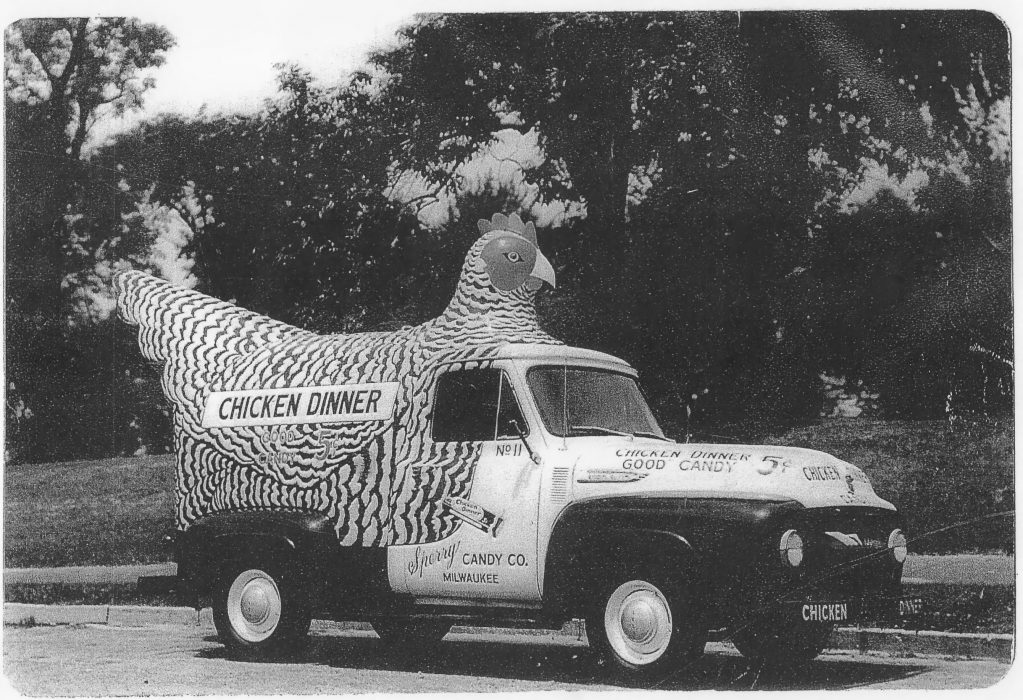
Milwaukees Sperry Candy Co. is remembered for its popular – if oddly named – "Chicken Dinner" candy bars, which it delivered in an equally odd fleet of chicken-shaped trucks. Photo courtesy Milwaukee County Historical Society.

Milwaukee’s Sperry Candy Co. is remembered for its popular – if oddly named – “Chicken Dinner” candy bars, which it delivered in an equally odd fleet of chicken-shaped trucks. Photo courtesy Milwaukee County Historical Society.

From its beginnings in a one-room factory on National Avenue in 1921, the Sperry Candy Co. grew into one of Wisconsin’s largest candy makers. By the 1940s, 275 workers in a five-story factory at 133 W. Pittsburgh St., were producing Sperry’s 5-cent “Chicken Dinner” and “Denver Sandwich” candy bars for customers nationwide.

One of those workers was Inonia Champion.

(more…)

Wilkie James and the measure of greatness

Wilkie James headstone
Garth “Wilkie” James, a brother of the famed novelist Henry James, is buried in Milwaukee’s Forest Home Cemetery. Carl A. Swanson photo

The five children of Henry James Sr. include some of America’s greatest thinkers.

Henry’s oldest son, the philosopher and educator William James, is considered the father of American psychology and his second son (and namesake) Henry James Jr. wrote 22 novels, hundreds of short stories, and many volumes of biographies, travel writing, art criticism, and memoirs. A third son, Robert, showed promise as an artist and writer until alcoholism derailed his career. Their sister, Alice, taught history but suffered from psychological and physical illness much of her life. Her sharply observed and insightful diaries, published after her death, are still widely read and admired.

Then there is the fourth son. Garth Wilkinson “Wilkie” James was born in New York City in 1845, Wilkie was an undistinguished student, experienced many failures, and died young and penniless.

Of all the James family siblings, guess who ended up in Milwaukee.

(more…)

Riverwest’s hidden landmark

Milwaukee River Pumping Station

This brick structure on the bank of the Milwaukee River in Riverwest is part of the city’s water utility. When it entered service in 1924, its massive pumps set a world record. Carl A. Swanson photo

On a stretch of the Milwaukee River once home to both ice houses and a lost neighborhood, only one structure remains – a five-story-tall, windowless brick building. Although well maintained and surrounded by neatly mown lawn, no sign identifies it and its purpose isn’t immediately obvious.

Here, at the foot of East Chambers Street in Riverwest, the city built a record-setting engineering landmark. This 92-year-old building is the Milwaukee Water Works Riverside Pumping Station. (more…)

Buses, bikes, and forgetfulness

Since 2009, all Milwaukee County Transit System buses feature front-mounted bicycle racks. Users simply fold them down, secure their bikes, and, often, forget they're there. Carl A. Swanson photo

Milwaukee County Transit System buses feature front-mounted bicycle racks. Users simply fold them down, secure their bikes, and, quite often, forget they put them there. Carl A. Swanson photo

In 2009, all Milwaukee County Transit System buses received front-mounted bike racks. The racks are extremely popular – more than 100,000 bikes are carried each year. Although it hardly seems possible, it’s quite common for a bus to return to its depot at the end of the day with a forgotten bike on its rack. Last year about 120 bikes were lost, an average of one every three days.

Most are reunited with owners. Strangely, some never call to retrieve their bicycles. What happens to those?

(more…)

A landmark church in Shorewood turns 100

Luther Memorial Chapel, Shorewood

Establishing this Shorewood church took an unusually persistent man. Luther Memorial Chapel in Shorewood marks its 100th anniversary in 2016. Carl A. Swanson photo

Slightly built and bespectacled, 30-year-old Rev. Theodore Kissling had already lived an adventurous life when his church’s mission board asked him, in 1914, to organize a congregation in the fast-growing community that would become Shorewood.

That church, Luther Memorial Chapel, 3833 N. Maryland Ave., marked its 100th anniversary in 2016. Oddly, both its choir and Sunday School are older than the congregation itself. It’s a story of twists, turns, setbacks – and a young pastor who overcame them all.

(more…)

Red Arrow: The park that moved

"Red Arrow" division insignia

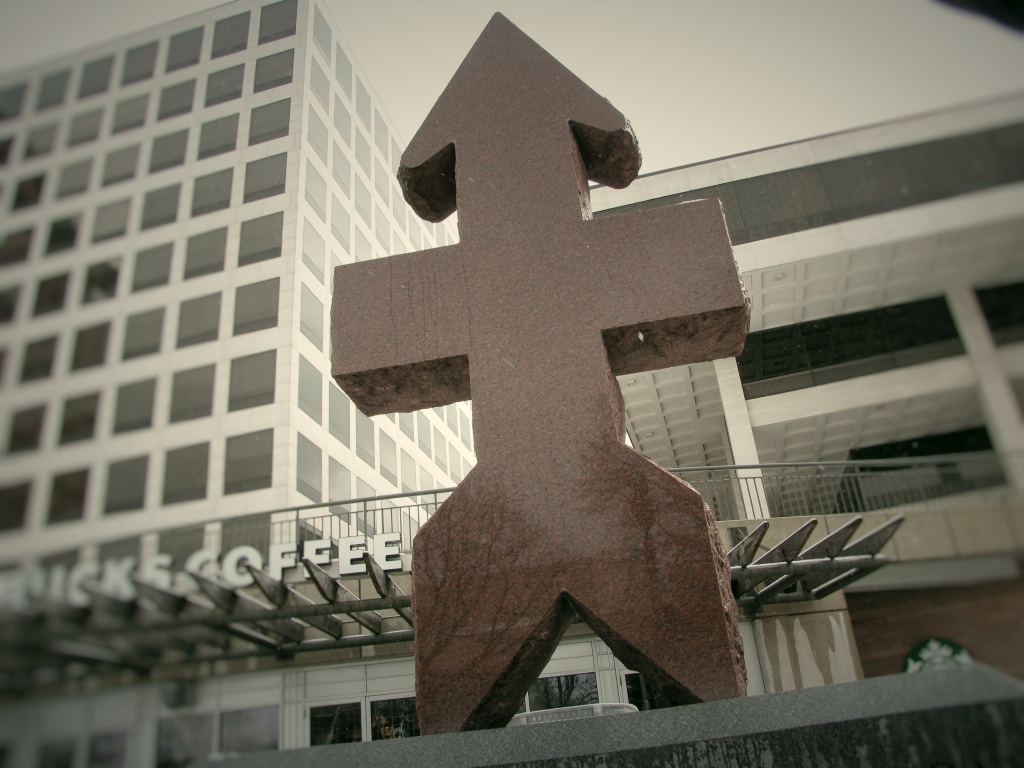
Since the 1920s, Milwaukee has had a park dedicated to local soldiers who fought with the 32nd Red Arrow division of the U.S. Army. The 8-foot-tall divisional insignia was added in 1984. Carl Swanson photo

Milwaukee has always considered park names open to change. The strip of greenery in the median in front of Central Library, for instance, was once Washington Park. The present-day Washington Park was originally West Park. Pere Marquette Park is along the downtown riverfront, formerly it was several blocks south and in front of the Milwaukee Road station. The station is gone, but there is still a park – now called Zeidler Union Square.

And then there is the strange history of Red Arrow Park.

(more…)

Safe haven for deserters

Screen Shot 2016-02-22 at 12.42.30 PM

The Water Street store of Ludington, Birchard and Co., where trigger-happy Army officers were not welcome. Illustration from James S. Buck’s Pioneer History of Milwaukee.

In his Pioneer History of Milwaukee, early settler James S. Buck notes the fledgling city became a safe-haven for U.S. Army deserters in the 1830s.

In those years, Buck wrote, the existence of hell as a punishment for the wicked in the hereafter was much debated among theologians but an earthly hell, “certainly as far as the common soldiers were concerned,” was a reality. It was in Portage, Wis., and it was called Fort Winnebago.

(more…)

Milwaukee’s sweetest story

Brix Apartment Lofts

Twenty tons of candy were made each day in this seven-story building at 408 W Florida St. The former home of the George Ziegler Candy Co., it was recently remodeled into upscale housing and is now known as the Brix Apartment Lofts. Carl A. Swanson photo


Enjoy this sample chapter from the book, Lost Milwaukee, by Carl Swanson, published by the History Press.


Although its reputation has more to do with brewing than bon bons, Milwaukee once ranked among the top five candy-producing cities in the United States. Even in the bleak years of the Great Depression, the city′s 16 candy factories employed 2,000 people with annual sales of $7.8 million. One of the 16 firms, the George Ziegler Candy Co., was founded before the Civil War and lasted into the 1970s. Its annual production averaged 12 million pounds, the Milwaukee Journal noted in a 1920 article. That’s about 20 tons of candy produced each working day. This is a story about chocolate. And a fire hose. But mostly chocolate. (more…)

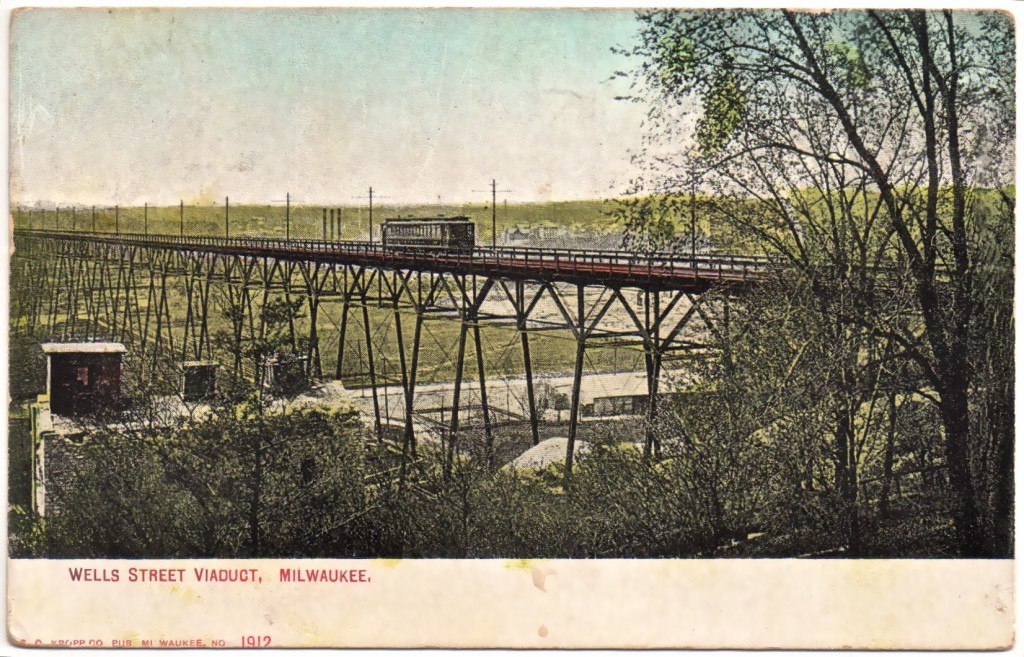
A postcard dated 1909 shows a streetcar crossing the 1892 Wells Street viaduct.

Thrills on the Wells Street Viaduct

A postcard, dated 1909, shows a streetcar crossing the viaduct. The 2,085-foot-long Wells Street viaduct was the Milwaukee streetcar system's greatest engineering feat. Built in 1892, it remained in service until the end of trolley service in 1958. Carl A. Swanson collection
A postcard, dated 1909, shows a streetcar crossing the viaduct. The 2,085-foot-long Wells Street viaduct was the Milwaukee streetcar system’s greatest engineering feat. Built in 1892, it remained in service until the end of trolley service in 1958. Carl A. Swanson collection

Enjoy this sample chapter from the book, Lost Milwaukee, by Carl Swanson, published by the History Press.


Nothing remains today, but for 60 years, the Wells Street viaduct was a Milwaukee landmark and the single greatest engineering achievement of the city’s once-vast streetcar and interurban empire.

As a thrill ride, albeit an unintentional one, the viaduct had few equals – especially when high winds buffeted the cars. Even veteran riders felt apprehensive as their streetcars rattled and swayed across the rickety-looking 2,085-foot-long bridge, 90 feet above the Menomonee River valley.

(more…)