History

All history is local, in this case the locality is Milwaukee

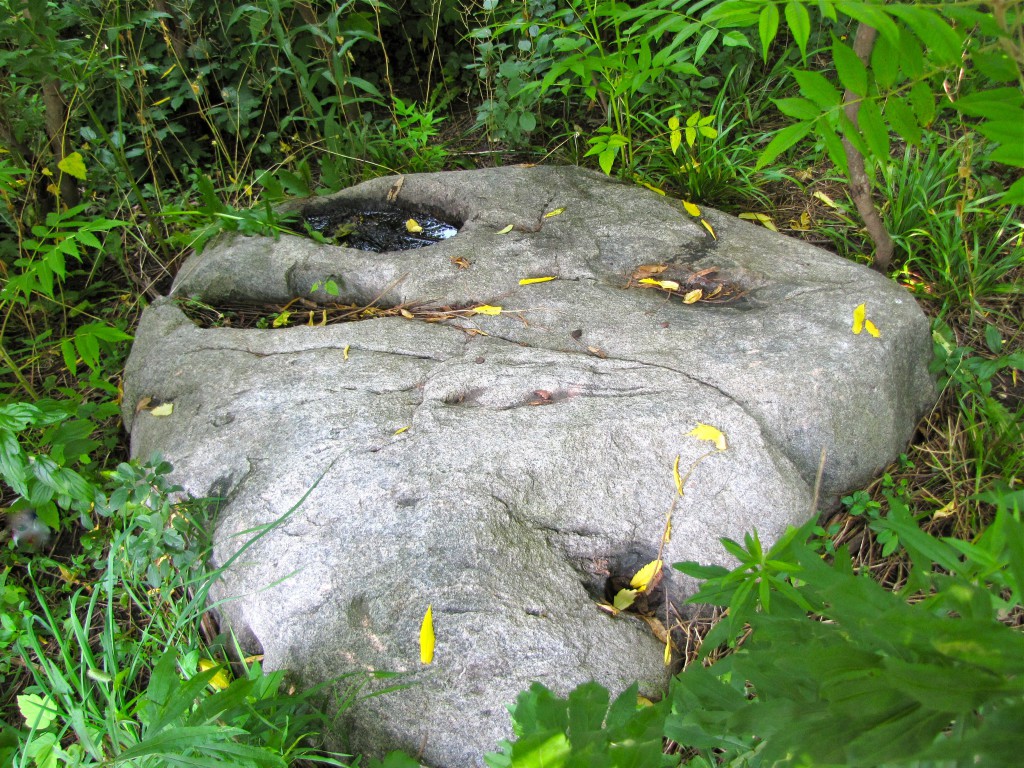
An ignored Estabrook Park artifact hints at early Indian settlement

This large, flat rock in Estabrook Park with its two deep oval-shaped hollows, was thought to have been used by early Native Americans to grind corn. The rock was once quite a historic attraction for the park. It appears to be completely forgotten now. Photo by Carl Swanson

This large, flat rock in Estabrook Park with its two deep oval-shaped hollows was said to have been used by early Native Americans to grind corn. Once this was an important  historic attraction for the park but now has seemingly been forgotten. Photo by Carl Swanson

On May 14, 1952, the Milwaukee Journal printed an article promoting the idea of an automobile trip to various Milwaukee County Parks, including Estabrook. The article advised visitors not to miss an artifact that was then a well-known attraction in the park but today has been forgotten. (more…)

How the 1927 Capitol Drive bridge saved part of the Milwaukee River

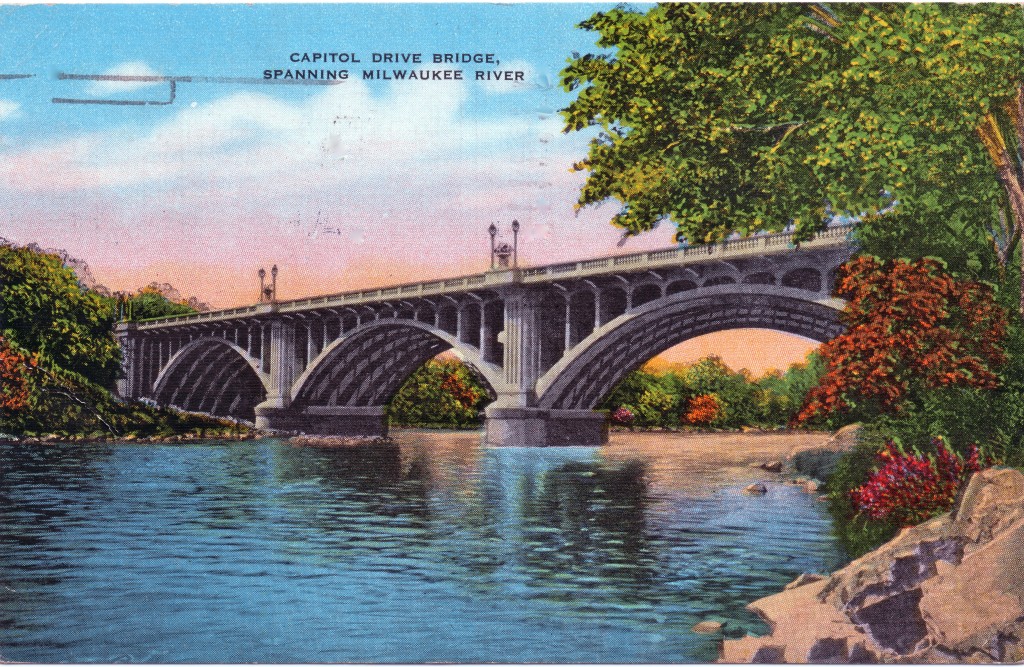
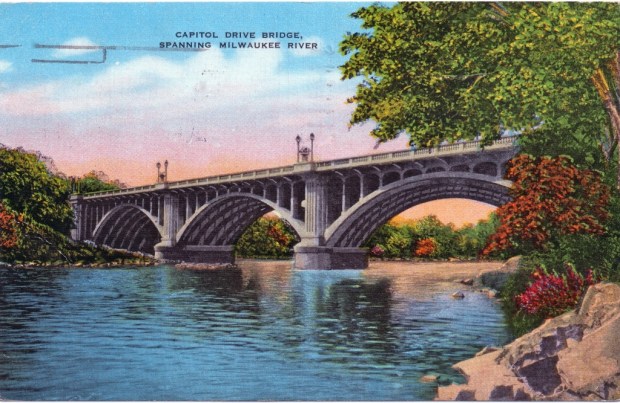
Spanning 532 feet and requiring more than 20,000 tons of concrete, the former Capitol Drive bridge over the Milwaukee River was an imposing structure. The bridge was built in 1927. This postcard was mailed in 1946. Carl Swanson collection

Spanning 532 feet and requiring more than 20,000 tons of concrete, the former Capitol Drive bridge over the Milwaukee River was an imposing structure. The bridge was built in 1927. This postcard was mailed in 1946. Carl Swanson collection

Vintage postcards can be odd. Why on earth would a visitor send the folks back home this postcard of the 1927 Capitol Drive bridge?

Before answering that question, there’s a funny thing about this bridge. In a roundabout way, it saved part of the Milwaukee River from being filled in for a riverside roadway.

In summer 1931, four years after this bridge opened, Shorewood started dumping rubble into the river along on the east bank, south of Capitol Drive, with the intention of narrowing the river by 35 feet and building a roadway along the river.

The planned first section extended north from the foot of East Menlo Boulevard, (basically today’s Hubbard Park), under the Capitol Drive bridge, to a junction 300 feet north of the bridge with the Milwaukee County parkway through Estabrook Park.

Shorewood Village Manager Harry Schmitt told the Milwaukee Journal he hoped the city of Milwaukee would soon follow suit and build a river drive of its own connecting the Shorewood portion of the road southward along the water’s edge to Riverside Park and a connection with East Newberry Boulevard.

In 4 to 5 years, he confidently predicted, motorists would be able to cruise alongside the Milwaukee River for several miles. The road, Schmitt added, was the only way to give the public the benefit of the use of the riverbank.

Schmitt clearly believed filling in a big chunk of the river for a new road was completely reasonable and no opposition could arise.

He was mistaken.

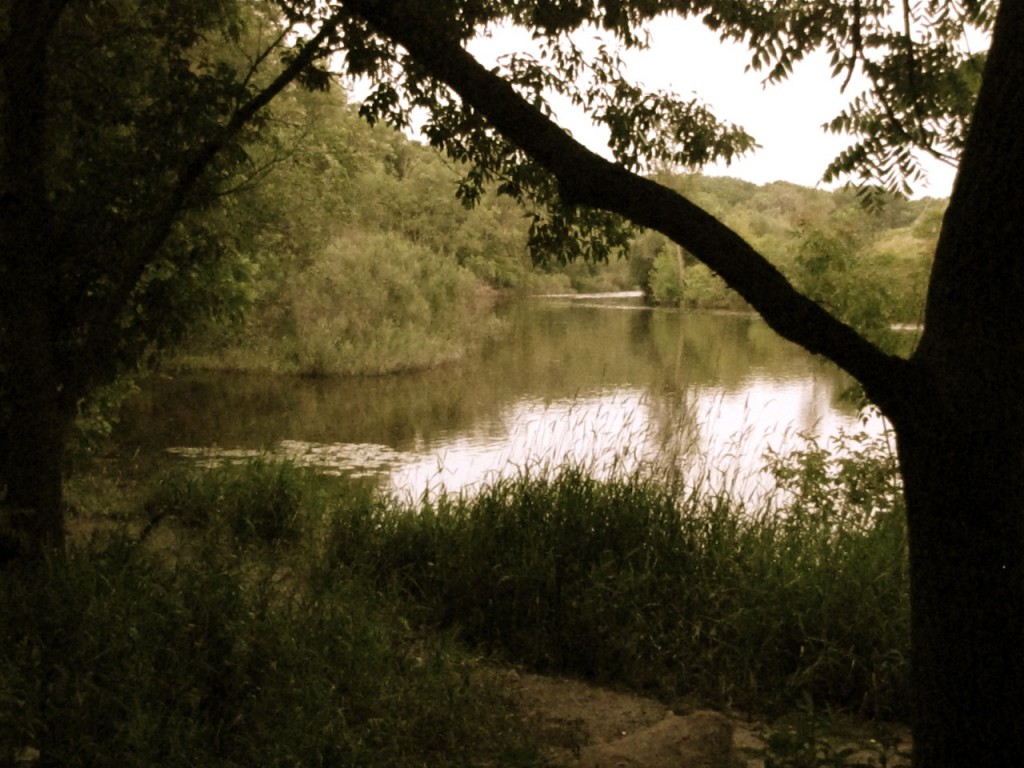
The current Capitol Drive bridge is nothing to write home about. On the other hand, if Shorewood's plans had gone through, this picture would have been taken from the middle of a two-lane road. Photo by Carl Swanson

The current Capitol Drive bridge is nothing to write home about. On the other hand, if Shorewood’s plans had gone through, this picture would have been taken from the middle of a two-lane road. Photo by Carl Swanson

Just four days later, Schmitt received a phone call from the state Public Service Commission ordering the village to cease dumping fill in the river. The action followed a joint protest filed with the PSC by Milwaukee city and county officials. They pointed out Shorewood’s village limits extend only to the natural east bank of the Milwaukee River and not to the center of the stream, as might normally be expected where two communities meet at a river. In other words, since the entire width of the riverbed is inside Milwaukee’s city limits, Shorewood was dumping fill outside of its jurisdiction.

Ironically, it was Shorewood’s own action in an earlier dispute that may have doomed its river roadway.

When the 1927 Capitol Drive bridge was in its planning stages (it replaced a spindly steel truss contraption so narrow there was scarcely room for two vehicles to pass), the city of Milwaukee asked Shorewood to share the cost. The village categorically refused, pointing to its founding charter that set the community’s boundary at the water’s edge and included no part of the river itself.

To Shorewood’s dismay, Milwaukee remembered this piece of historical trivia and turned it against the village four years later.

Getting back to the original question: Why were postcard buyers attracted to views of bridges? We usually think of bridges—if we think of them at all—as utilitarian ways to get from here to there.

In 1927 people would have seen things differently. The new Capitol Drive really was a marvel. Not because it cost a jaw-dropping $400,000 in pre-depression dollars and not because it took 20,000 tons of cement to build, but because it connected the entire north side of Milwaukee with the entire North Shore by way of an impressively long, wide, and elegant piece of engineering.

They were seeing the big picture. That’s certainly worth the price of a postcard, even if all you could fit on the back is, “Having a great time in Milwaukee, wish you were here.”

Carl Swanson is the author of the book Lost Milwaukee from The History Press, available from book stores or online.

Amid the ruins of Gordon Park

gordon_park_stairs_southside

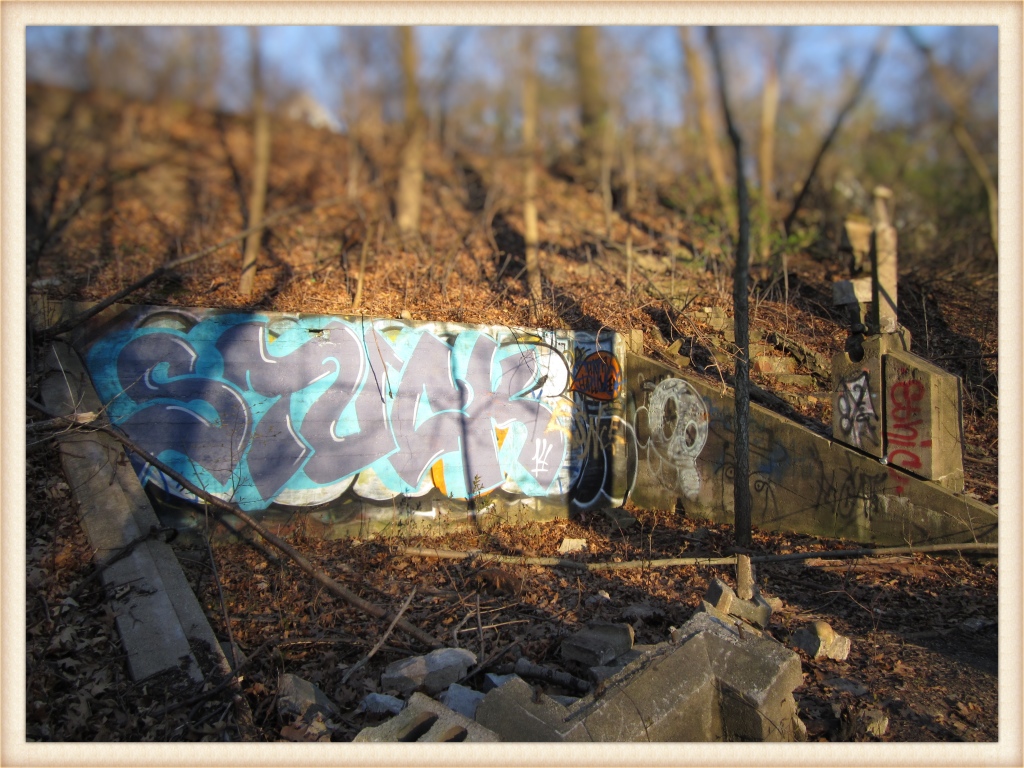
A retaining wall is a reminder of Gordon Park’s bathhouse, built 100 years ago along the west bank of the Milwaukee River. Photo by Carl Swanson

Enjoy this sample chapter from the new book, Lost Milwaukee, by Milwaukee Notebook blogger Carl Swanson

Deep in the trees along the west bank of the Milwaukee River near the Locust Street bridge is a strange sight: a century-old concrete retaining wall, with two sets of stairs leading down into a field of tall grass. The wall is all that remains of the Gordon Park bathhouse, a point of considerable civic pride when it opened one hundred years ago but ultimately cursed by its location and by steadily worsening water pollution.

(more…)

Estabrook Park’s forgotten swimming beach

Built along a bend in the Milwaukee River, the swimming beach at Estabrook Park was a popular place to cool off on a hot day. The river is unusually wide here because the river bed was heavily quarried more than a century ago, creating a deep man-made lake known as the "blue hole." Photo by Carl Swanson
Built along a bend in the Milwaukee River, the swimming beach at Estabrook Park was a popular place to cool off on a hot day. The beach was abandoned almost 70 years ago. Photo by Carl Swanson

Estabrook Park, on the east side of the Milwaukee River north of Capitol Drive, has much to offer. There is a disc golf course, a popular dog exercise area, and an even more popular beer garden. The swimming beach, however, has been closed for nearly 70 years.

In other news: There was a swimming beach at Estabrook Park.

Even on a hot day, most people would hesitate before jumping into the Milwaukee River, but the river was once enormously popular for swimming. Kletzsch, Estabrook, and Gordon parks had swimming areas and there were at least three private swim schools located near the North Avenue dam. Gordon Park, with its beautiful bathing house, is fairly well-known among long-time Milwaukeeans but Estabrook Park’s beach is nearly forgotten.

(more…)

Photo Friday: Happy 4th of July!

milwaukee_postcard

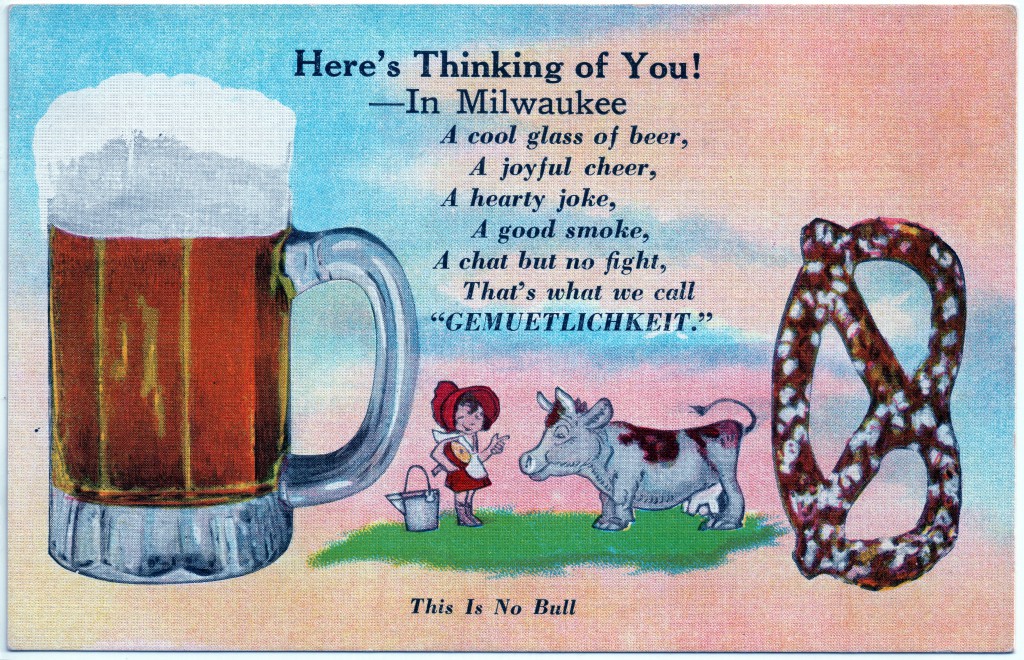
“The proverbial German word gemütlichkeit is difficult to explain,” says the Germany National Travel Board. “But you won’t go far wrong if you think of good food, good company, a drink or two and plenty of time to enjoy it all.” It can also imply a feeling of well-being and peace in an atmosphere of social acceptance.

Germans can pack a lot of meaning in one word, admittedly very long and convoluted words.

This antique postcard, from long-gone Milwaukee printer E.C. Kropp Co., explains how to get your party on, Milwaukee style: “A cool glass of beer, A joyful cheer, A hearty joke, A good smoke, A chat but no fight, That’s what we call “Gemuetlichkeit.” And, adds the footnote, “This is no bull.”

Happy 4th!

a_favor_requested

River Colony, Milwaukee’s lost neighborhood

River Colony foundation

Only foundations remain of River Colony, a former neighborhood of a half-dozen year-round homes on the east bank of the Milwaukee River on the north side of the Locust Street bridge. The homes faced the water. Immediately to their rear the river bank climbed steeply to a railroad cut made by the Chicago & North Western Railway (today’s Oak Leaf Trail). East of the railroad tracks, the ground again rose steeply to Cambridge Avenue, about forty feet above the colony. Photo by Carl Swanson

Just north of the Locust Street bridge, Cambridge Woods Park narrows considerably squeezed between the Milwaukee River and the Oak Leaf Trail. Here the walking path passes a number of tightly spaced crumbling concrete foundations, some covered with graffiti, some barely more than rubble amid the weeds and wildflowers.

You are walking across the doorsteps of River Colony and in its day this was one of the most unusual neighborhoods in Milwaukee.

(more…)

Blue Ribbon memories

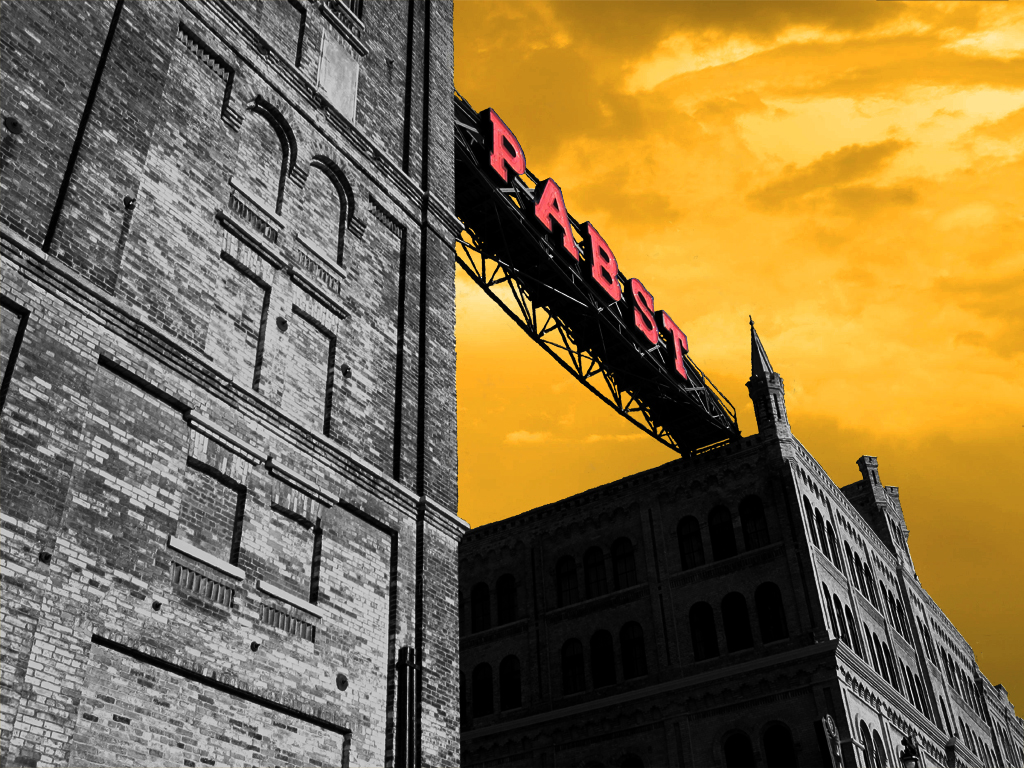
Although the area is undergoing rapid development, some of the original Pabst buildings remain. Photo illustration by Carl Swanson

Although the former Pabst brewery complex in Milwaukee is being converted into a mixed-use development, some of the original buildings remain. Photo illustration by Carl Swanson

When I moved to Milwaukee 25 years ago I did what everyone does. I toured the Pabst Brewery. Because, free beer.

Of course, Pabst Blue Ribbon is not in the same class as Riverwest Stein, but what is?

I arrived five minutes after the day’s last tour had departed, which is pretty much the story of my life. However, the people at the visitor’s center were very nice. A group from Germany had arranged for a private tour but they probably wouldn’t mind me tagging along.

The tour was led by a young woman who was good at her job but rather hampered by the German group’s overbearing leader. The Pabst guide would say one or two sentences then we all stood around for 10 minutes or so to let Mr. Bossy-Britches harangue his merry band of Krauts.

(more…)

Decoration Day

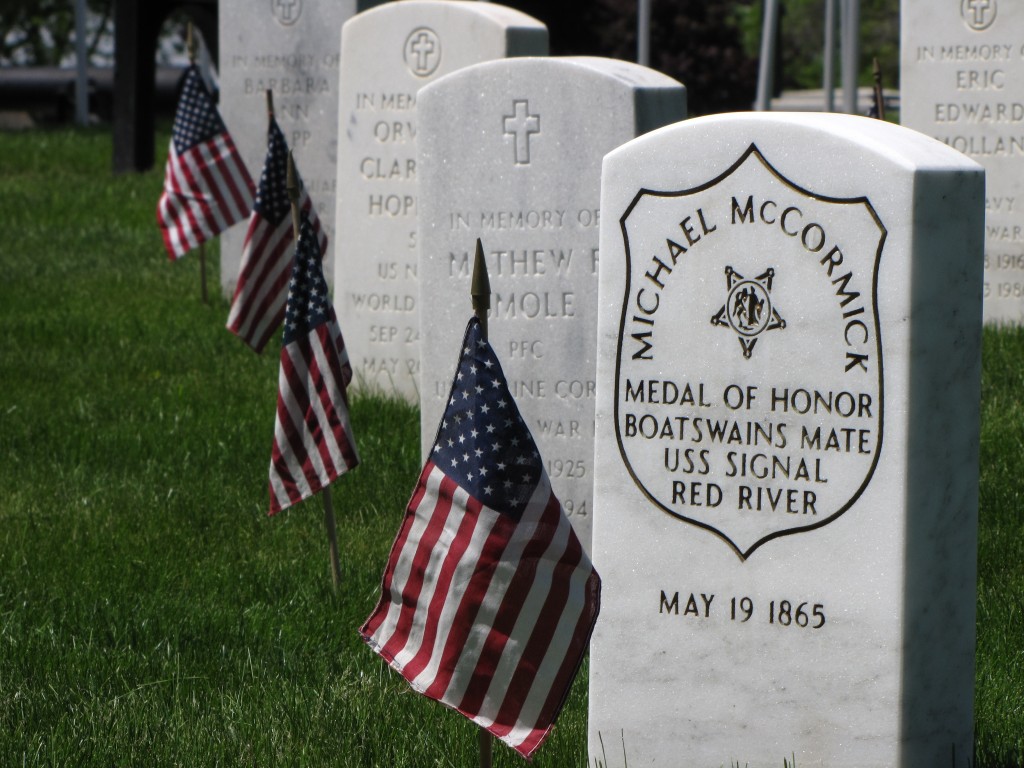
May 30 was once set aside as a day to remember those who died in the Civil War, such as U.S. Navy Boatswain's Mate Michael McCormick, who was born in Ireland in 1833 and died on May 19, 1865 at the age of 32. He is buried in Wood National Cemetery in Milwaukee. Photo by Carl Swanson

May 30 was once set aside as a day to remember those who died in the Civil War, such as U.S. Navy Boatswain’s Mate Michael McCormick, who was born in Ireland in 1833 and died on May 19, 1865 at the age of 32. He is buried in Wood National Cemetery in Milwaukee. Photo by Carl Swanson

In 1868, the Grand Army of the Republic, a veteran’s organization for Union Civil War veterans, called for May 30th to be observed annually as a day to remember the 620,000 Americans killed in the Civil War. Originally called Decoration Day, the May 30th holiday gradually became known as Memorial Day. In 1968, Congress passed the Uniform Monday Holiday Act, moving four holidays, including Memorial Day to specified Mondays to create three-day weekends.

On this Decoration Day, take a moment to remember U.S. Navy Boatswain’s Mate Michael McCormick, who served aboard the U.S.S. Signal, a 190-ton stern-wheel paddle steamer of the type derisively called a “tinclad” for the half-inch steel armor protecting its main deck, sufficient to stop a rifle bullet but offering no protection against cannon shells. Under the plating, the ships were entirely made of wood, Tinclads were cheap, expendable, and, in the words of one naval historian, “complete fire traps.”

The U.S.S. Signal was a “tinclad” paddlewheel steamer built in 1862. Disabled by Confederate artillery fire on the Red River in Louisiana on May 4, 1864, the ship was burned by its crew to prevent its capture. Photo courtesy U.S. Naval Historical Center

The U.S.S. Signal was a “tinclad” paddlewheel steamer built in 1862 and destroyed in battle on May 4, 1864. Photo courtesy U.S. Naval Historical Center

On May 4, 1864, the Signal, was proceeding downstream on the Red River in Louisiana when it was fired upon by Confederate cavalry. A running battle ensued for the next four miles until the Signal encountered sister ship U.S.S. Covington and the John Warner, an Army transport ship. Trapped near Dunn’s Bayou near Alexandria, Louisiana, the gunboats exchanged point-blank cannon fire with Confederate field artillery on both banks. At one point in the uneven fight, the Signal was hit 38 times in four minutes.

(more…)

From landmark to landfill: The 1921 North Avenue Viaduct

North Avenue Bridge, Milwaukee

The North Avenue viaduct opened to traffic in 1921. The 1,385-foot-long reinforced concrete bridge was designed by Marquette University professor James C. Pinney and included large public restrooms at either end and “detailed neoclassical ornamentation,” all long gone when this photograph was taken in 1987. Photo courtesy Library of Congress, Prints and Photographs Division, HAER, Reproduction number HAER WIS,40-MILWA,51–1

Completed in 1921 and demolished in 1990, the 1,385-foot-long North Avenue Viaduct was the fourth bridge at this location and certainly the most beautiful.

Using state-of-the-art (for its era) construction techniques, the reinforced concrete bridge featured large public comfort stations (restrooms) at either end, along with “detailed neoclassical ornamentation,” such as railings supported by 3,000 concrete balusters, the casting of which was the full-time occupation of seven workers during the bridge’s two-year construction.

Deterioration was evident as the bridge entered the 1980s and so was the lasting elegance of its design. Photo courtesy Library of Congress, Prints and Photographs Division, HAER, Reproduction number HAER WIS,40-MILWA,51--2

Deterioration was evident as the bridge entered the 1980s and so was the elegance of its design. Photo courtesy Library of Congress, Prints and Photographs Division, HAER, Reproduction number HAER WIS,40-MILWA,51–2

But seven decades of wear and tear can claim even an engineering masterpiece. In 1984, the Public Works Department decided the old viaduct was beyond repair and started planning its replacement. Projects of this magnitude take time, and by 1987 increasingly worried city officials had shored up parts of the viaduct with timber, banned vehicles over 10 tons, and were conducting weekly inspections.

In 1988 Milwaukee newspapers ran a legal notice from the city offering to sell the bridge on the condition the buyer disassemble the 1,385-foot-long structure, rebuild it elsewhere, and maintain it forever.

To sweeten the deal, the city offered to pay up to $1.3 million of the relocation costs. This would be, mused Milwaukee Sentinel reporter Amy Rinard in the June 30, 1988 edition, an opportunity to own a piece of Milwaukee history – a really big piece. Her story also noted the offer of sale was a legal formality mandated by the viaduct’s status as a registered historic landmark. City officials quoted in the paper spelled out the obvious: It would be impossible to move the bridge.

(more…)

One nation, united by beer

In 1888, Milwaukee’s Jos. Schlitz Brewing Company distributed this 15 x 26-inch chromolithograph poster. Courtesy Library of Congress Prints and Photographs Division, LC-DIG-pga-04220 (digital file from original print).

In 1888, Milwaukee’s Jos. Schlitz Brewing Company distributed this 15 x 26-inch chromolithograph poster. Courtesy Library of Congress Prints and Photographs Division, LC-DIG-pga-04220 (digital file from original print).

According to the caption supplied by the Library of Congress, “the man on the left looks like what Joseph Schlitz might have looked like had he been alive at the time of this advertisement. The other man may be a representative of ‘P.M. Ohmeis & Co.’”

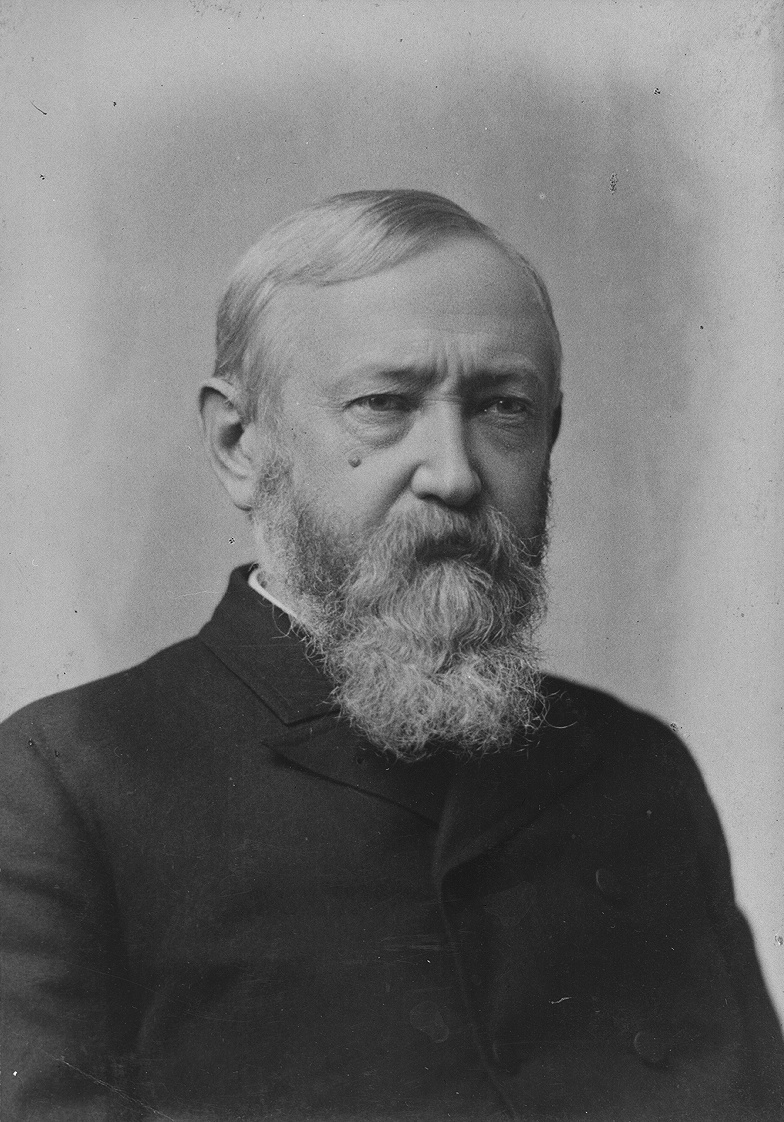
Benjamin Harrison

Benjamin Harrison

Far be it from me to argue with the Library of Congress, but its caption is obviously wrong and kind of weird. “What Joseph Schlitz might have looked like had he been alive at the time.” Really? I guess nothing says, “Drink up!” like an artificially aged dead beer baron.

This broadsheet was printed in 1888, a presidential election year. The man at the left in the poster is the Republican candidate, Benjamin Harrison. The man in the center of the poster is his opponent, the Democrat incumbent president Grover Cleveland.

The Schlitz Brewing Co. was making the humorous point that good beer is one thing everyone can agree on.

Grover Cleveland

Grover Cleveland

Cleveland narrowly won the popular vote that year but Harrison won the electoral college by a substantial majority (233 to 168 votes) and consequently became the 23rd president of the United States.

But don′t shed any tears for Cleveland. He served as president twice. He defeated Harrison four years later, making Cleveland both the 22nd and 24th president – the only one to serve non-consecutive terms in office. You can win a lot of barroom bets knowing that bit of trivia.

The idea of these two hanging out and having a few beverages together is not so far fetched. It rained at Harrison′s inauguration. Outgoing President Cleveland not only attended the ceremony, he held an umbrella over Harrison’s head while he took the oath of office.Carl_sig

a_favor_requested