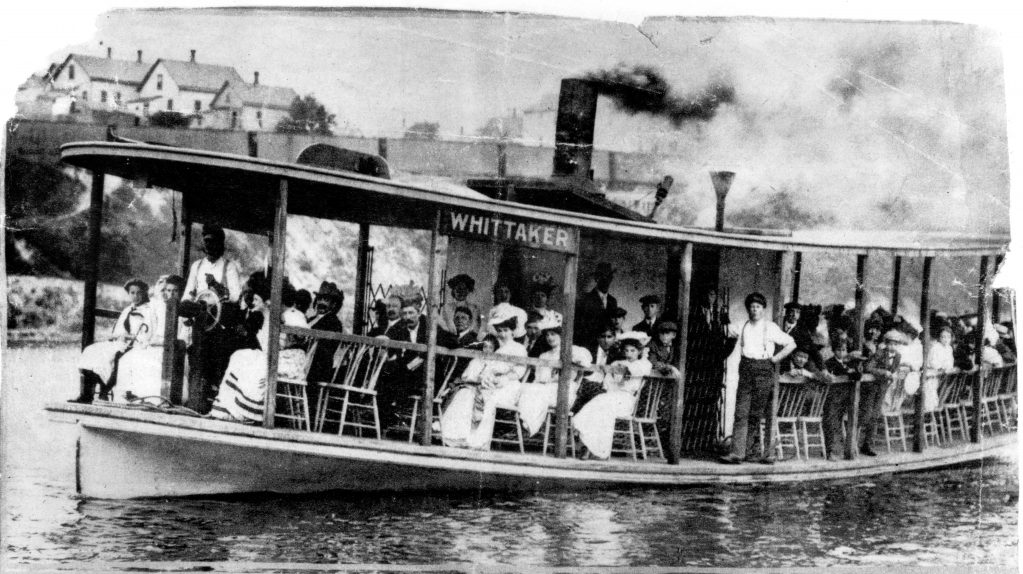
The Whittaker was one of several steam-powered excursion boats plying the upper Milwaukee River in the late 1800s. Carl A. Swanson collection
In 1835, Byron Kilbourn, the developer of the west side of the city, built a dam across the Milwaukee River south of North Avenue. A log structure filled with earth and gravel, the dam was 480 feet long and 18 feet tall. It was designed to ensure a steady flow of water for a canal.
The canal was supposed to connect Milwaukee with the Mississippi River but financial troubles halted construction after a single mile had been dug. But Kilbourn’s dam changed the river — and the city — in ways he could not have imagined.(more…)
Canoes crowd the Milwaukee River at Gordon Park on a fine summer day in the early 1900s. Judging by the spectators lining the railing of the Folsom (now Locust) bridge, an aquatic contest is about to take place. Carl Swanson collection
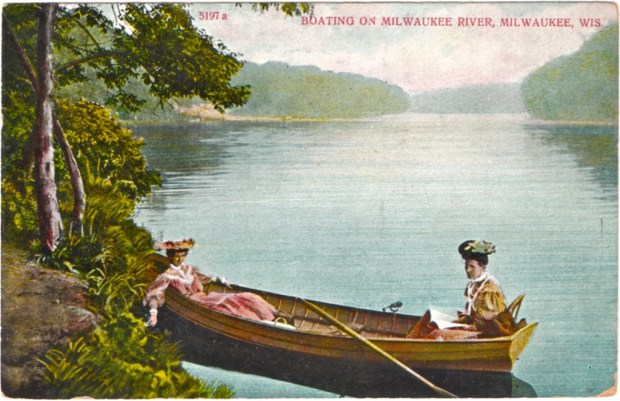
The North Avenue dam, built in 1843, divided the Milwaukee River into an industrialized lower river through downtown to the harbor and a relatively untouched upper river, which became a center for recreation for the growing city. Here, from the late 1800s to World War I, you could take a steamboat from North Avenue up the river to visit a beer garden or an amusement park. For the more energetic, there were businesses at both ends of the North Avenue bridge renting canoes and row boats by the hour or by the day.
And there were boat clubs. A newspaper article from 1912 listed 20 boat clubs on the Upper River with a membership of around 300. The clubs had names like White Squadron, Pleasant Valley, La Fa Lot, Sun Set, and Shady Nook. If the article had been written a few years earlier, it would have included the Daphne Boat Club.
Pleasant Valley Park on the west bank of the Milwaukee River was once one of the city’s most popular beer gardens. Owned by the Blatz brewery and visited by thousands, it featured elaborate landscaping, a restuarant, bandshell, pavilion, steamboat dock, and even a few cottages. Little remains to remind visitors of its glory days a century ago. Photo by Carl Swanson
Pleasant Valley Park, at the foot of East Concordia Avenue on the Milwaukee River, is a peaceful place. The band packed up and left a century ago, about the time the steamboats stopped calling at the park’s dock. A little later, the pavilion, pier, cottages, and bandshell were torn down and the rubble removed. Officially this is a Milwaukee County Park but you wouldn’t know it by looking at it. There are no signs, no parking area, no picnic benches or ball fields, nothing at all to suggest it had ever been anything other than a ravine filled with downed trees and garlic mustard.
But once this was one of Milwaukee’s best-known beer gardens:
“Blatz Park (“Pleasant Valley” before 1892) swarmed with picnickers in those days. Troops of large families from St. Casimir’s Parish, a mile south, regularly followed a makeshift marching band up Humboldt Avenue to the park, each family pulling a coaster wagon containing a picnic lunch. Steam-powered boats, sailing from a dock just above the North Avenue dam, pulled up periodically at the pier and discharged crowds of passengers. The park had a bandshell and later a restaurant. There were also cottages, often rented in the summer, by one account, to actors from a theatre downtown.” – From Riverwest: A Community History, by Tom Tolan, copyright 2003, Past Press, Milwaukee, WI.
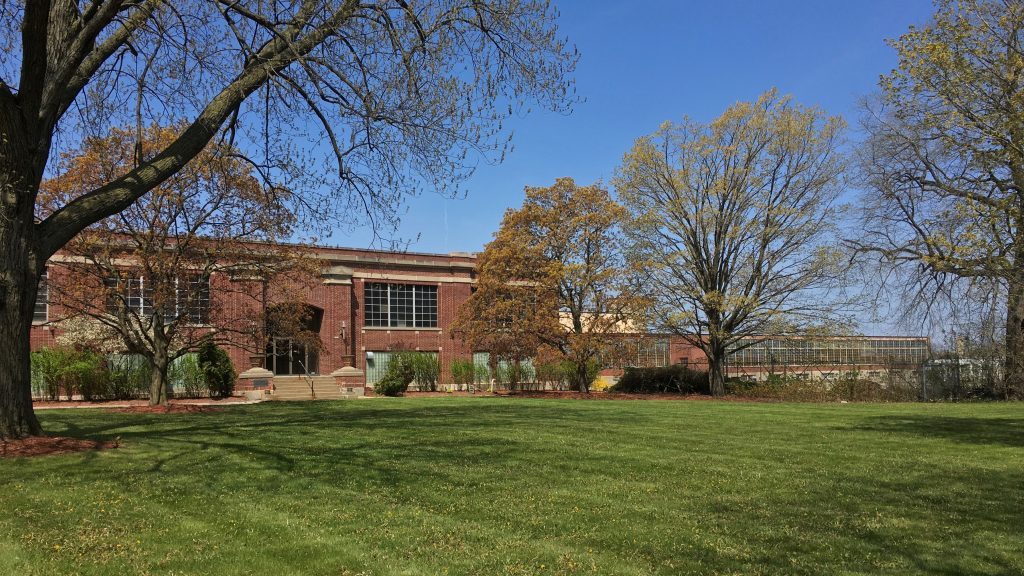
The former Cottrell & Sons, Claybourn Division printing press manufacturing plant at 3701 North Humboldt Boulevard is vacant today but it has a proud heritage. Carl Swanson photo
A color printing press is a miraculous machine. As big as a house (and the newest ones are much bigger than that), packed with rollers and gears turning at blinding speed, producing tens of thousands of printed sheets per hour, they are so precisely made that a single part misaligned by a few thousandths of an inch would ruin the output.
One of the early pioneers in color printing, Leslie Claybourn, built a factory in Riverwest in 1922 and his workers were soon turning out printing presses that were more innovative, massive, and precise than any before. His company attracted visitors from around the globe and even held the record for a time for the world’s largest color press.
Then, in 1957, it all came to an end. Other companies would occupy the 172,344-square-foot factory at 3701 North Humbolt Boulevard over the subsequent years.
Leslie Claybourn was born in Albert Lea, Minnesota, in 1884. He started an electroplating company and then a machine shop. Business being slow at times, he augmented his income by moonlighting as a professional wrestler. Known as Lex “The Terrible Swede” Claybourn, he was good enough to hold the lightweight championship at one point.
It is not known when he hung up his wrestling tights, but by 1914 he was working as a development engineer for a Cincinnati printing machinery company. In 1918, Claybourn became vice president and director of operations for the Menasha Printing & Carton Co. While there, he perfected a process for printing pictures on butter and ice cream cartons.
His patented techniques, involving both improved machinery and new ways of producing printing plates, attracted a great deal of industry attention. In 1921 he was able to organize the Claybourn Process Corporation and build a large factory on Humboldt near Keefe Avenue.
One of the company’s first customers was the Milwaukee Journal. Other newspapers followed, including The New York Times. The Philadelphia Inquirer, Cleveland Plain Dealer, and many more. By 1929, Conde Nast was printing Vogue on a Claybourn five-color press.
In a 1929 article, a national trade publication, The Pressmen’s Journal, wrote, “Mr. L.W. Claybourn is one of the outstanding geniuses of the printing industry of the world, and it has been said by many authorities in the printing and printing machinery fields that Mr. Claybourn is actually 25 years ahead of the industry.”
On the last day of 1930, Claybourn’s car was involved in a collision at the interaction of North Prospect and East Newton avenues. So violent was the impact that Claybourn’s car was thrown sideways into a unity pole, snapping it off at its base. He spent all of 1931 in a cast and never fully recovered from his injuries.
It would take more than that to sideline “The Terrible Swede.” In 1934, the Claybourn company made headlines when it unveiled a 72-ton five-color press able to print 4,000 sheets per hour while cutting set-up time in half. The gain in efficiency was startling. This high-speed full-color press could be up and running as quickly as a simple two-color press.
But in those dark years of the Great Depression excellence in design and manufacture might not be enough to save a company. In 1937, with the Milwaukee plant struggling to stay afloat, Connecticut-based C.B. Cottrell & Sons Company acquired the firm.
Claybourn stayed briefly to help with the transition, then moved on to work with many other printing firms. At the time of his death in 1956, he held more than 200 patents for printing innovations.
The Riverwest plant’s new owner, Cottrell & Sons, traced its roots as a machine builder all the way back to 1855. By the time of the Civil War, the firm was specializing in printing presses. The firm sent Donald Cottrell, grandson of the founder, to manage its newly acquired Milwaukee operation. A graduate of Harvard, he had served as captain of an infantry company in World War I. He also had a local connection—Charles Ilsley, chairman of the board of Marshall & Ilsley Bank, was a classmate of his at Harvard.
Cottrell would lead the company out of the Depression and through years of wartime production in World War II.
In 1943, the company plowed a 13,000-square-foot plot near the factory and its employees planted and tended a victory garden. The Milwaukee Journal reported that, among other things, the garden had 480 tomato plants, which produced far more than its employees could consume at home. A bushel basket of tomatoes was kept in the factory in late summer for snacking. Their agricultural efforts earned the company’s workers a trophy from the National Victory Garden Institute.
In 1953, Cottrell & Sons was itself taken over by the Harris-Seybold Co. and the Milwaukee plant had another owner. By 1955, the factory had 165 employees and was building rotary color presses that weighed 40 tons and measured 42 feet long.
Two years later, Harris-Seybold closed the Humboldt factory and a piece of Milwaukee’s industrial heritage died.
In 2015, the Wisconsin Historical Society sponsored a survey to find industrial properties that might be eligible for inclusion in the National Register of Historic Places. The report concluded the C.B. Cottrell & Sons, Claybourn Division factory is “significant as an example of an early-twentieth-century industrial complex with a consolidated plan. The first factory and warehouse were constructed in 1922, and the Classical Revival main office was constructed in 1927. In the 1950s and 1960s, the plant expanded at the rear; however, the complex retains the character-defining features of the form including the large expanses of original window sash, roof lighting, and a consolidated plan. The C.B. Cottrell & Sons buildings retain a high degree of integrity and are therefore potentially eligible.”
If a historical marker is erected, which seems unlikely, it might quote the founder, Leslie Claybourn, who told The Pressmen’s Journal in a 1929 interview, “Printing is a mechanical problem. Establish accuracy and precision into the locked-up form to be printed or moulded from, which is the very foundation of the printed job, and you will print that form correctly in spite of yourself.”
Maybe it could also mention the tomatoes.
Interested in learning more about Milwaukee’s fascinating (and occasionally odd) history? Check out my book. (Paid link)
This factory, the former home of Globe-Union, at 900 E. Keefe Ave., was once the employer of electronics genus Jack Kilby, and may even have started him on a path that eventually changed the world. Carl A. Swanson photo
The device upon which you are reading this, the network you used to access it, along with every modern computer, smartphone, GPS device, in fact, the entire digital age was born in 1958 when Jack Kilby, an electronics engineer with Texas Instruments, designed the first integrated circuit built on a piece of semiconductor material. As Thomas Fehring, author of the new book, The Magnificent Machines of Milwaukee and the engineers who created them, explains, this world-changing invention may have its roots in a company located in Milwaukee’s Riverwest neighborhood.
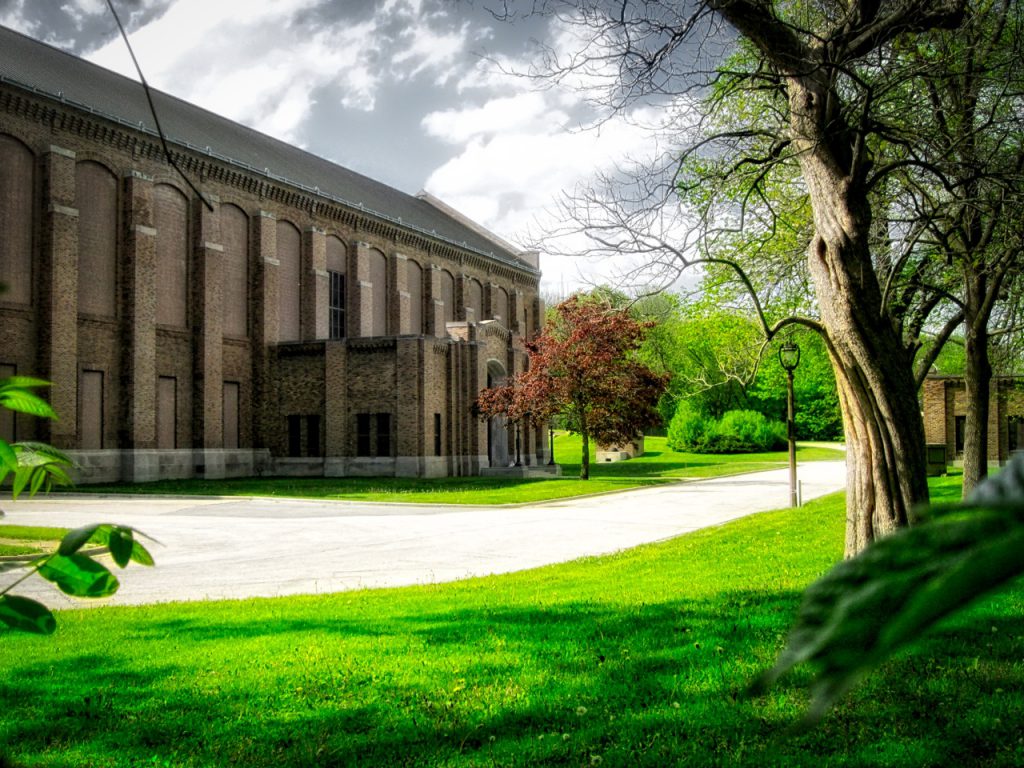
This brick structure on the bank of the Milwaukee River in Riverwest is part of the city’s water utility. When it entered service in 1924, its massive pumps set a world record. Carl A. Swanson photo
On a stretch of the Milwaukee River once home to both ice houses and a lost neighborhood, only one structure remains – a five-story-tall, windowless brick building. Although well maintained and surrounded by neatly mown lawn, no sign identifies it and its purpose isn’t immediately obvious.
Here, at the foot of East Chambers Street in Riverwest, the city built a record-setting engineering landmark. This 92-year-old building is the Milwaukee Water Works Riverside Pumping Station. (more…)
The Gordon Park bathing pavilion was the most popular blog post for the second year running. Photo by Jos. Brown.
Thank you for a great year in 2015! This blog was viewed 29,000 times in the past year. In 2015, 43 new posts were added to the site (for a total of 90) and 378 pictures uploaded, about a picture per day.
These are the top five posts of 2015. Have you read them all?
Doors Open Milwaukee was held Saturday and Sunday, September 19th and 20th. About 200 locations, many normally closed to the public, were open for visitors. Here are five of my favorite places to visit during this annual event.
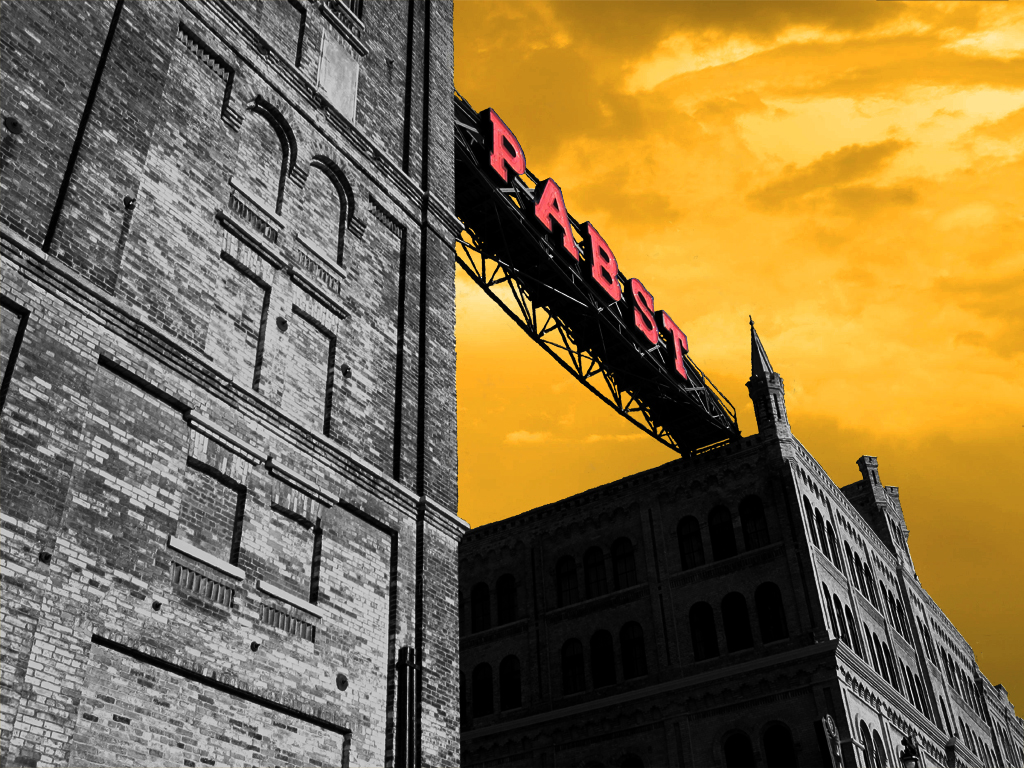
1. Former Pabst Brewery
Although the area is undergoing rapid redevelopment, some of the original Pabst buildings remain. Photo by Carl Swanson
Tour a speakeasy (actually, the former plant infirmary and ancient storage tunnels) at the Best Place at the Historic Pabst Brewery, 901 W. Juneau Ave. The speakeasy is open if the red jelly jar light is illuminated at the doorway marked “J.C. Haertel Real Estate & Financial Consulting.” The Pabst Brewing Co. was the subject of this Milwaukee Notebook post. (more…)
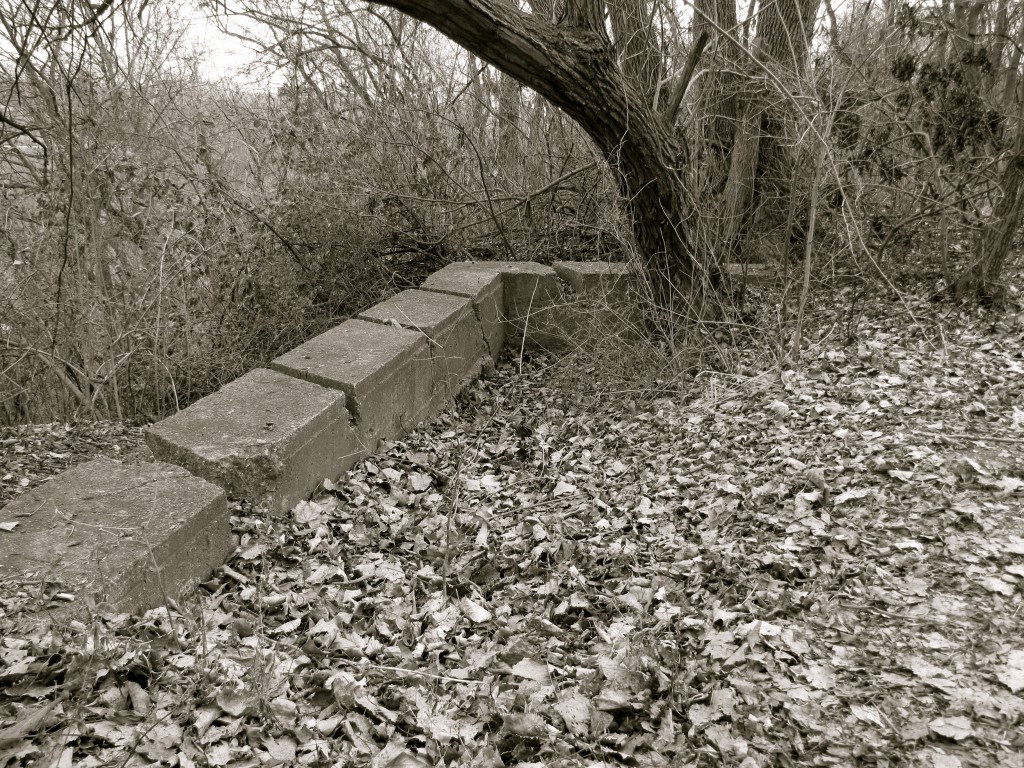
This concrete foundation, atop a river bluff south of Gordon Park, was part of the Wisconsin Lakes Ice & Cartage Company’s Center Street icehouse, destroyed in a massive fire a century ago. Carl Swanson photo
A concrete foundation in the woods south of Gordon Park in Milwaukee’s Riverwest neighborhood is all that remains of the Wisconsin Lakes Ice & Cartage Co. Center Street icehouse. The 350 x 100-foot icehouse, built in the late 1800s alongside the Chicago, Milwaukee & St. Paul RR’s “Beer Line,” was one of several icehouses on the upper Milwaukee River. The icehouse burned to the ground in a spectacular multi-alarm fire in June 1911.







 Milwaukee Notebook